

As Ethereum trades at $1,969.73, up a modest $26.46 over the past 24 hours, its Layer 2 ecosystem faces a pivotal moment. Cross-rollup sequencing emerges not as flashy hype, but as a pragmatic evolution addressing the core frictions in rollup proliferation. With rollups fragmenting liquidity and state across optimistic and zk variants, unified transaction ordering via shared sequencers promises genuine interoperability without compromising Ethereum’s security model.

Individual rollups, each with proprietary sequencers, have scaled throughput admirably. Yet this siloed approach breeds inefficiencies. Transactions submitted to Arbitrum rarely interact atomically with those on Optimism, forcing users into cumbersome bridges prone to delays and exploits. Maximal Extractable Value extraction, or MEV, compounds the issue: searchers exploit ordering within a single rollup but miss cross-rollup opportunities, distorting markets and eroding trust.
Fragmentation’s Hidden Costs in Rollup Dominance
Consider the data: over a dozen major rollups now capture significant Ethereum activity, yet liquidity pools remain balkanized. A DeFi trader bridging assets between Base and Scroll waits minutes, if not hours, for finality, all while facing slippage from uncoordinated ordering. Cross-rollup MEV, as highlighted in recent analyses, represents untapped yet risky value extraction when transactions span chains. Without synchronization, bundles cannot guarantee atomic inclusion, leaving dApps vulnerable to front-running across ecosystems.
Cross-rollup MEV refers to opportunities for value extraction that arise when transactions across different rollups can be profitably sequenced or manipulated.
This fragmentation stifles composability, the very promise of modular blockchains. Developers building multi-rollup protocols grapple with asynchronous state reads, undermining user experience in multi-chain DeFi. Economic security suffers too; solo sequencers, often centralized in early stages, invite censorship risks that pooled networks could mitigate through diversified staking.
Shared Sequencers: Neutral Ordering at Scale
Shared sequencers invert this paradigm by decoupling ordering from individual rollup execution. A decentralized network of sequencer nodes broadcasts a single, verifiable transaction log to all participating rollups, ensuring consistent global order. Projects like Espresso Systems and Astria pioneer this, leveraging threshold signatures for liveness and fault tolerance aligned with Ethereum’s proof-of-stake.
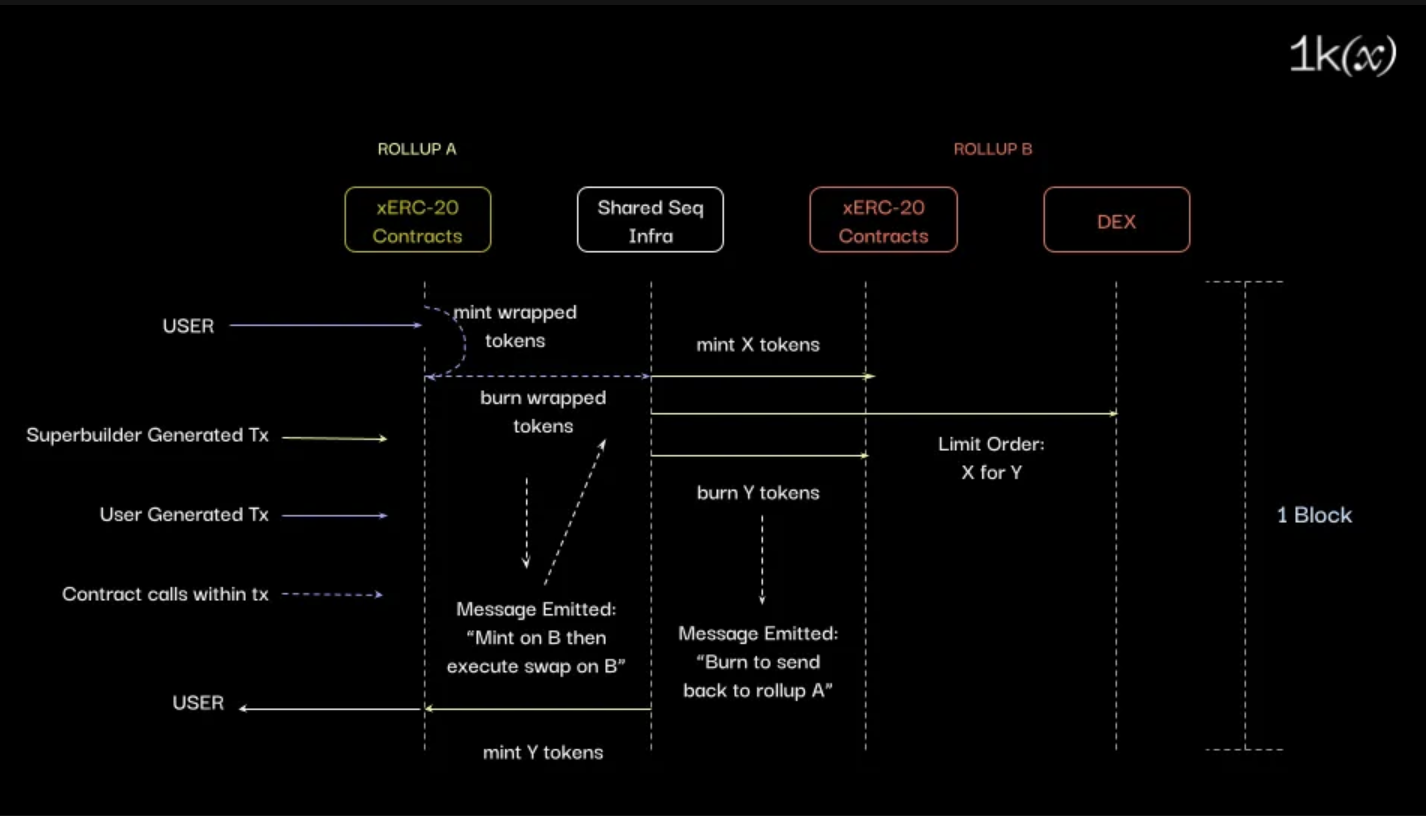
The mechanics are straightforward yet profound. Users submit transactions to the shared layer, which batches and orders them permissively before dissemination. Rollups then execute locally, posting commitments back to Ethereum L1. This yields synchronous visibility: a transaction on one rollup sees the full context from others in the same sequencing unit. For investors, this conservatism appeals; no radical protocol shifts, just enhanced coordination atop proven infrastructure.
Rollup interoperability leaps forward with predictable ordering. Atomic cross-rollup operations become feasible, enabling intents-based trading where a swap on Uniswap across Arbitrum and OP Mainnet executes in one bundle. Hyperbridge-like protocols complement this, streamlining asset transfers while shared sequencing handles the ordering guarantee. Yet prudence dictates caution: shared sequencers alone fall short of full conditional execution, as noted in interoperability stack evolutions; they unify order but not arbitrary logic.
MEV capture improves markedly. Unified ordering captures cross-rollup arbitrage hitherto lost, redistributing proceeds via auctions to rollup operators and stakers. This aligns incentives conservatively, bolstering L2 security without L1 subsidies. At Ethereum’s current $1,969.73 price, such efficiencies could sustain TVL growth amid rising gas demands, favoring long-term holders over speculative flips.
Credible neutrality remains paramount. Sequencer sets must resist collusion, often through Ethereum-aligned proofs and slashing. Early implementations prioritize this, pooling resources for censorship resistance that solo setups envy. For Web3 builders, this unifies the sequencing marketplace, much like IPFS standardized storage.
Leading initiatives underscore this potential. Espresso Systems deploys a shared sequencer emphasizing rollup interoperability through cross-rollup bridging and atomic transaction execution. Their network leverages a sequencing layer accessible to multiple rollups, fostering unified liquidity pools essential for scalable DeFi. Astria, meanwhile, targets credible neutrality with operator sets diversified across geographies and staking mechanisms tied to Ethereum L1. These efforts pool economic security, reducing per-rollup overheads while enhancing censorship resistance.
Key Projects Driving Shared Sequencer Adoption
Espresso Systems vs. Astria: Shared Sequencer Comparison
| Feature | Espresso Systems | Astria |
|---|---|---|
| Interoperability | Enables rollup interoperability including cross-rollup bridging and atomic transaction execution | Enables atomic cross-chain operations with predictable ordering for bridging and multi-chain DeFi |
| Neutrality Mechanisms | Decentralized sequencing layer ensuring credible neutrality | Credible neutrality through shared, decentralized infrastructure |
| Ethereum Alignment | Deep alignment with Ethereum’s security principles | Deep alignment with Ethereum’s security principles |
| Stage of Development | In active development with testnets; at forefront of shared sequencers (2026) | In active development; pioneering shared sequencer networks (2026) |
| Economic Security Model | Pooled resources across rollups for stronger economic security and censorship resistance | Enhanced economic security and censorship resistance via shared sequencers |
Such projects address solo sequencer pitfalls head-on. Pooled staking distributes risk, mirroring Ethereum’s validator economics at $1,969.73 ETH price levels where L2 incentives matter increasingly. Yet investors must scrutinize governance: centralized operator risks persist until full decentralization materializes. Cross-rollup sequencing thrives on alignment, not overpromising.
For developers, the value proposition centers on composability. Shared ordering enables dApps to span rollups seamlessly, from ENS-like shared state stores to multi-chain intents. Hyperbridge protocols layer atop this for trustless bridges, but true atomicity demands sequencing guarantees. As Ethereum Research notes, read-only shared state unlocks keystores and registries, paving pragmatic paths forward without full state unification.
MEV redistribution forms another pillar. Unified auctions capture cross-rollup opportunities, channeling proceeds to stakers and reducing negative externalities. This conservative incentive design bolsters L2 viability as Ethereum’s base layer fees stabilize around current market conditions. Traders benefit from fairer ordering, curbing front-running that plagues siloed chains.
Investment Thesis: Patience in Ethereum L2 Evolution
From a fundamental standpoint, cross-rollup sequencing merits allocation within conservative Ethereum L2 portfolios. At $1,969.73, ETH underpins this ecosystem, with rollup TVL growth signaling demand for interoperability fixes. Projects demonstrating Ethereum-aligned proofs and audited threshold cryptography warrant due diligence. Avoid hype-driven tokens; focus on sequencer networks with operator bootstrapping and liveness proofs.
Risks loom, however. Shared sequencers mitigate but do not eliminate centralization vectors. Atomic inclusion guarantees next-block bundling yet falters on complex conditionals, as interoperability analyses caution. Regulatory scrutiny on MEV markets adds uncertainty, demanding vigilant monitoring. Success hinges on Ethereum’s modular thesis: execution sharded, settlement unified, sequencing shared.
Real-world traction builds methodically. Cube Exchange highlights atomic cross-chain operations enhancing multi-chain DeFi UX, while Maven 11 stresses pooled security gains. Polkadot comparisons underscore Ethereum-centric advantages in rollup interoperability standards. For institutional investors, this evolution supports long-term compounding via efficient capital deployment across L2s.
Superchain Thesis details how shared sequencers enable atomic cross-rollup trades in the OP Stack, exemplifying OP Stack synergies.
Developers and operators stand to gain most. Unified sequencing marketplaces lower barriers, inviting zk and optimistic rollups alike. Reduced latency and costs amplify dApp performance, capturing value in a fragmented landscape.
Cross-rollup sequencing positions Ethereum for sustained dominance in modular blockchains. By unifying transaction ordering, it unlocks liquidity, tames MEV, and fortifies security without Ethereum L1 overhauls. As rollups proliferate, shared layers emerge as indispensable infrastructure, rewarding patient capital committed to verifiable progress over transient narratives.
About the Author