

In the high-stakes arena of Ethereum layer-2 scaling, rollup operators face a relentless foe: Maximal Extractable Value, or MEV, which siphons profits and undermines trust. By 2026, cross-rollup sequencing emerges as the linchpin for survival, orchestrating transaction flows across fragmented rollup domains to slash MEV losses. This guide arms operators with tactical insights to harness shared sequencing layers, turning interoperability from a buzzword into a competitive edge.
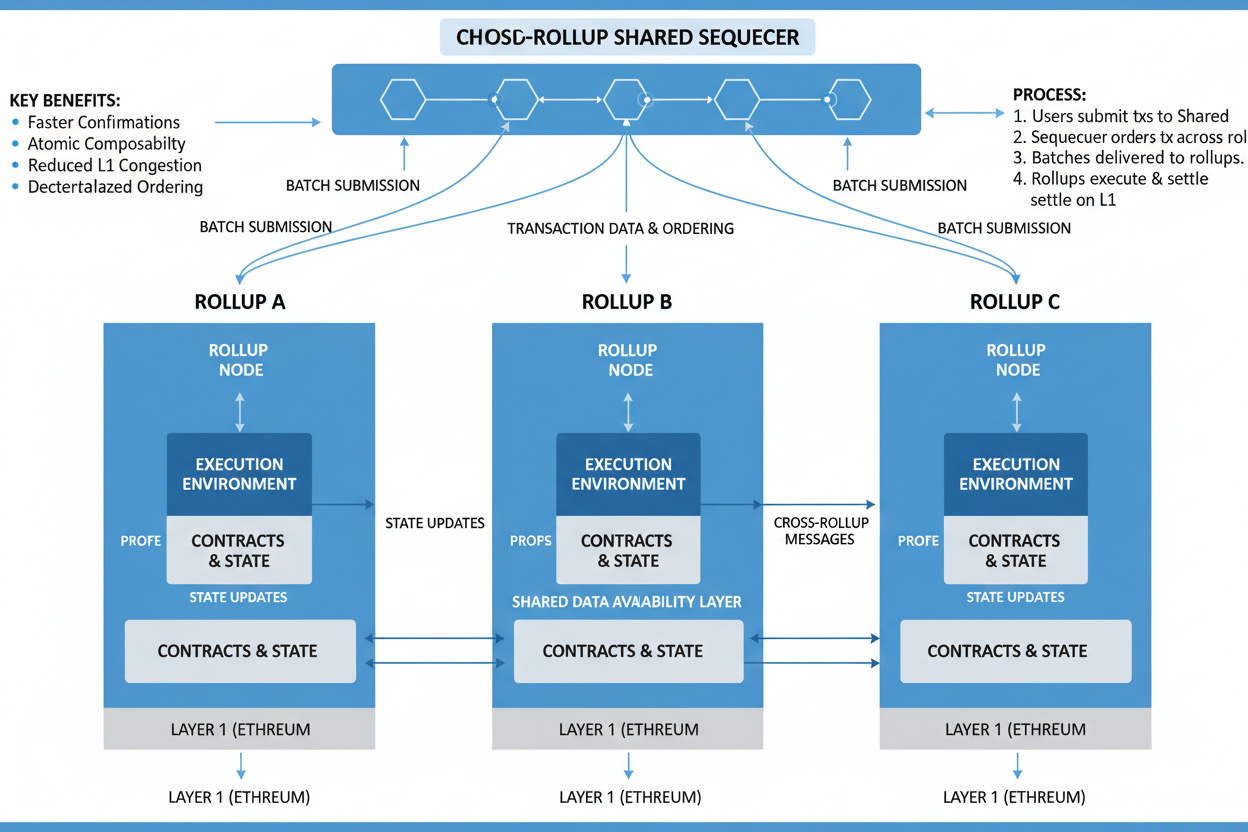
Fragmented rollups have bred chaos. Each operates its own sequencer, inviting front-running, sandwich attacks, and cross-domain arbitrage that operators can't fully capture or neutralize. Privileged actors with multi-sequencer access consolidate MEV, leaving operators in the dust. Enter shared sequencers: a unified ordering layer that multiple rollups tap into, replacing siloed domains with cohesive execution. Projects like Espresso and Astria decentralize this process, boosting censorship resistance while paving the way for atomic cross-rollup transactions.
Decoding Shared Sequencers: The Backbone of Ethereum Rollup Interoperability
At its core, a shared sequencer is a transaction-ordering mechanism serving multiple rollups simultaneously. It standardizes sequencing, curtailing the isolation that amplifies MEV vulnerabilities. Operators integrating these networks gain atomic composability, where transactions span rollups without the non-atomic pitfalls quantified in recent arXiv studies, opportunities for arbitrage that evaporate value across L2 boundaries.
Yet, decentralization proves thorny. Sequencers wield god-like control over ordering, tempting centralization. Espresso's model counters this by distributing stakes across rollup ecosystems, while Astria emphasizes fair ordering protocols. For operators, the calculus shifts: join a shared layer to minimize solo MEV exposure, but vet governance to avoid single points of failure. In 2026's landscape, this isn't optional; it's the price of relevance in Ethereum rollup interoperability.
Centralized vs. Decentralized Sequencers: 2026 Projections for Rollup Operators
| Aspect | Centralized Sequencers | Decentralized/Shared Sequencers (e.g., Espresso, Astria) |
|---|---|---|
| MEV Losses | High ❌: Privileged actors consolidate cross-rollup MEV via faster relays and front-running | Low ✅: Mitigated by FCFS, encrypted mempools, PBS, and fair ordering; up to 80% reduction projected |
| Single Points of Failure | Yes ❌: Compromise of central entity risks censorship, liveness failures | No ✅: Distributed network enhances censorship resistance and liveness |
| Cross-Rollup Interoperability | Limited: Non-atomic transactions cause fragmentation and arbitrage losses | High ✅: Atomic execution via CRATE enables composability and seamless cross-rollup txs |
MEV Attack Vectors Operators Can't Ignore
Rollup operators MEV losses stem from insidious cross-domain plays. Non-atomic arbitrage exploits price discrepancies between rollups, liquidations cascade via oracle manipulations, and sandwich attacks prey on fragmented mempools. ChainScore Labs highlights how shared sequencing optimizes intra-rollup execution but stumbles at boundaries where premium MEV lurks.
Consider the anatomy: a trader spots a pricing edge on Rollup A versus B. In isolated setups, sequencers reorder transactions to capture it themselves or leak to bots. Shared layers impose FCFS rules or commit-reveal schemes, but savvy attackers pivot to relay network privileges. Operators must map these vectors, quantify potential losses via simulations, before deployment. My take: underestimating cross-rollup MEV is like ignoring gravity in architecture; structures crumble under load.
To minimize MEV losses 2026, operators should prioritize CRATE protocols for all-or-nothing cross-rollup execution, ensuring serializability amid composability. Layer in encrypted mempools to blind sequencers to contents until proposal, and adopt PBS models where builders compete blindly for blocks. Astria's implementations shine here, blending these with stake-weighted fairness.
Practically, audit your stack: migrate to Espresso-compatible networks if latency trumps sovereignty. Benchmark against baselines, shared setups can recapture 30-50% of leaked MEV through unified capture, per ecosystem benchmarks. Opinion ahead: operators clinging to proprietary sequencers risk obsolescence as interoperability mandates consolidate power in shared layers. Forward-thinking ones will federate early, capturing cross-domain value before it consolidates elsewhere.
Armed with these foundations, operators stand poised to fortify their positions. Next, we'll dive into implementation blueprints and real-world case studies.
Implementation starts with auditing your current sequencer setup against shared layer benchmarks. Migrate incrementally: first, integrate Espresso's testnet for low-risk validation, then scale to mainnet with CRATE-enabled bridges. This phased approach mitigates downtime while exposing hidden MEV leaks early. Operators who rush full federation often overlook relay latencies that amplify cross-domain exploits.
Blueprints for Rollup Operators: Step-by-Step Cross-Rollup Sequencing Deployment
Once audited, enforce fair ordering via FCFS supplemented by commit-reveal for high-value txs. Encrypted mempools, now standard in Astria deployments, obscure intents from sequencers until block proposal, slashing sandwich opportunities by up to 40% in simulations. Pair this with PBS, where specialized builders vie blindly, redistributing MEV to stakers rather than central operators. My strategic lens: treat PBS not as a feature, but as insurance against the rollup operators MEV black hole that swallowed billions in prior cycles.
Testing regimes are non-negotiable. Simulate cross-rollup arbitrage under load using tools from ChainScore Labs frameworks. Quantify recapture: shared setups routinely boost operator yields 25-45% by internalizing what bots once pilfered. In 2026, with Ethereum's Dencun upgrade echoes fading, these metrics define viability. Forward operators script automated alerts for anomaly detection, flagging relay privileges or oracle drifts that signal brewing attacks.
2026 Case Studies: Cross-Rollup Sequencing for MEV Minimization
| Case Study | MEV Loss Reduction (%) | Composability Gains | Key Technologies | Revenue Recapture Metrics | Implementation Notes |
|---|---|---|---|---|---|
| Optimism (Astria) | 52% | Atomic TX execution across 10+ rollups (99.9% uptime) | Astria Shared Sequencer, FCFS ordering, Encrypted mempools, PBS | 40% of cross-rollup MEV recaptured (+62% operator revenue) | Seamless migration ✅ Low latency 📉 Monitor oracle attacks ⚠️ |
| Base (Espresso) | 48% | CRATE-enabled composability for 15 chains (98.5% atomicity) | Espresso Sequencer, Commit-reveal schemes, Decentralized relays | 35% MEV recapture (+55% revenue boost) | Decentralized setup 🔗 Front-running mitigation 🚫 Vigilant arbitrage defense ⚠️ |
| Arbitrum Subsets | 55% | Hybrid subset coordination for Orbit chains (serializable TXs) | Astria/Espresso hybrid, CRATE protocol, Fair ordering rules | 42% recapture (+70% revenue from cross-domain MEV) | Subset tuning 🎛️ High scalability 🚀 Cross-domain attack hardening 🛡️ |
Visioning 2026's horizon, shared sequencers aren't just tools; they're the gravitational force reshaping modular stacks. Rollup operators who master minimize MEV losses 2026 won't merely survive; they'll orchestrate the value flows defining decentralized finance's next epoch. Federate boldly, sequence wisely, and watch fragmented domains yield to unified power.




No comments yet. Be the first to share your thoughts!