Why rollups need shared sequencing
Right now, the Layer 2 landscape is a collection of isolated islands. Each rollup operates its own sequencer, ordering transactions within its own walls. This fragmentation creates a significant friction point for liquidity. When users want to move assets between different rollups, they are forced to rely on external bridges or decentralized exchanges that often suffer from high latency, complex multi-step interactions, and fragmented liquidity pools. The result is a user experience that feels disjointed and expensive, limiting the utility of L2s beyond simple, siloed transactions.
Shared sequencing addresses this by introducing a middleware layer that allows multiple rollups to order transactions together. Instead of each rollup acting as a solitary gatekeeper, a shared sequencer can process transactions from different chains in a single, unified block. This creates atomicity across chains, meaning that operations like swapping assets from Arbitrum to Optimism can be settled in one step rather than requiring a bridge contract and a separate execution layer.
The infrastructure shift is already visible in community discussions. Developers are increasingly advocating for shared sequencer networks to solve the "silos" problem that currently hinders mass adoption. By pooling sequencer resources, rollups can also benefit from stronger economic security and censorship resistance, as the load is distributed across a decentralized network rather than a single entity.
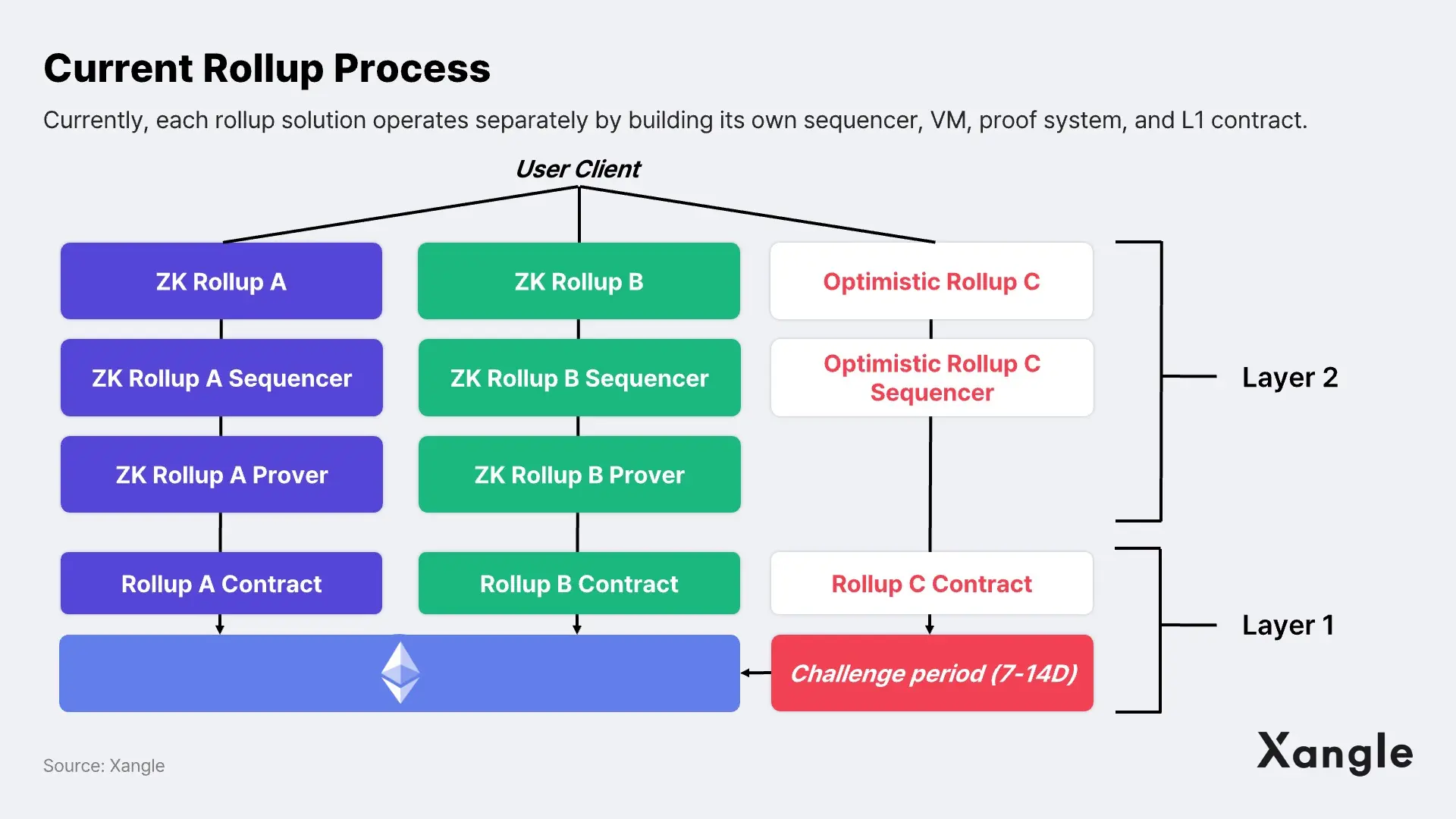
This approach changes the fundamental economics of L2s. Rather than competing for sequencer dominance, rollups can specialize in their application logic while relying on shared infrastructure for ordering. This specialization encourages innovation, as developers can focus on building better user experiences without worrying about the underlying mechanics of cross-chain settlement. The result is a more cohesive ecosystem where liquidity flows freely, and users interact with a unified network rather than a patchwork of disconnected chains.
How atomic execution works across chains
Cross-rollup synchronous atomic execution transforms how transactions are processed by allowing a single sequencer to order blocks for multiple rollups simultaneously. Instead of treating each Layer 2 network as an isolated silo, this shared sequencing infrastructure creates a unified ordering layer. When a user initiates a complex transaction that spans different chains—such as swapping assets on one rollup and depositing them into a lending protocol on another—the sequencer can bundle these actions into a single atomic unit.
The technical mechanism relies on a trigger-action paradigm. A smart contract on the source rollup acts as the trigger, invoking a method on a target rollup. The shared sequencer ensures that both actions are included in the same logical block window. If the execution on the target rollup fails, the entire transaction reverts, leaving the source rollup state unchanged. This prevents the common cross-chain failure mode where assets are locked on one chain because the corresponding action on the other chain did not complete.
This approach significantly reduces the friction of cross-rollup liquidity. Users no longer need to rely on trusted third-party bridges or wait for multiple confirmation rounds across disparate networks. The sequencer handles the coordination, ensuring that the state transitions on both chains are consistent. This coherence is critical for maintaining the integrity of the L2 ecosystem, where fragmented liquidity has historically been a major bottleneck for adoption.
"Is there anyone with a coherent thesis for how the L2 ecosystem eventually [comes together]?" Eric Wall asked on X, highlighting the industry's long-standing need for shared sequencing to unify fragmented liquidity.
"Is there anyone with a coherent thesis for how the L2 ecosystem eventually [comes together]?"— Eric Wall, Founder of Paradigm
While the technology promises efficiency, it introduces new considerations for MEV (Maximal Extractable Value). Because the sequencer controls the ordering of transactions across multiple chains, it has increased visibility into cross-chain arbitrage opportunities. Researchers are actively studying how to mitigate these risks, ensuring that the benefits of atomic execution are not undermined by centralized extraction. The goal is to create a system where cross-rollup transactions are fast and cheap, but also fair and resistant to manipulation.
The MEV problem in shared sequencing
Shared sequencing promises to stitch together the fragmented liquidity of Ethereum Layer 2s, but it introduces a complex new vector for Maximal Extractable Value (MEV). When a single sequencer orders transactions across multiple rollups, it gains the ability to see the full picture of cross-chain intent before any execution occurs. This visibility transforms what was once isolated arbitrage into a sophisticated game of atomic cross-rollup execution.
In this environment, MEV bots no longer just hunt for price discrepancies within a single chain. They can now construct complex strategies that exploit the timing gaps between rollup finality. For example, a bot might front-run a large swap on Arbitrum by predicting a correlated move on Optimism, ensuring profit regardless of which chain settles first. This creates a hostile environment for regular users, whose transactions may be reordered or sandwiched not just by local miners, but by global arbitrageurs with a bird's-eye view of the entire L2 ecosystem.
The infrastructure reality of 2026 highlights that this is not a theoretical risk but an active battleground. Community discussions on Reddit and developer forums frequently cite "shared sequencer centralization" as a primary concern, noting that a single point of ordering creates a single point of failure for fairness. As noted in community analyses, the efficiency gains of composability come with the steep cost of allowing centralized actors to potentially manipulate cross-chain markets.
Leading shared sequencer projects
The shift from isolated rollup silos to shared infrastructure is already underway, with specific protocols demonstrating how atomic execution can bridge liquidity gaps. These projects treat sequencing not as a private utility, but as a public good that enables cross-rollup communication.
Espresso Systems has positioned itself at the forefront of this transition. By offering shared sequencing and fast finality, Espresso allows different rollups to communicate securely without relying on centralized bridges. As noted by community observers, this architecture directly addresses the fragmentation that typically forces users to choose between performance and interoperability.
Meanwhile, the Celestia ecosystem is exploring decentralized sequencing as a service. By leveraging interchain security, new rollups can spin up with a set of existing sequencers and stake, rather than bootstrapping a trusted operator from scratch. This model reduces the centralization risk inherent in single-operator sequencers.

The technical foundation for these solutions often involves "shared validity sequencing." This architecture enables atomic cross-rollup transactions, ensuring that operations spanning multiple L2s are executed as a single, indivisible unit. This prevents the partial execution risks that plague current bridge mechanisms.
These examples show that the 2026 infrastructure reality is defined by interoperability. By sharing the sequencing layer, rollups can maintain their individual execution environments while benefiting from a unified, secure ordering mechanism.
What this means for multi-chain liquidity
Cross-rollup sequencing turns the current fragmented liquidity landscape into a single, unified order book. Instead of forcing users to bridge assets across separate L2s—a process fraught with bridge risks and latency—shared infrastructure allows transactions on different rollups to be ordered atomically. This means a swap on Arbitrum and a deposit on Optimism can be settled in the same block, effectively removing the "bridge" from the user's journey.
The result is a significant improvement in capital efficiency. Liquidity no longer needs to be stranded in isolated pools on each chain. Instead, it flows freely across the ecosystem, allowing traders to access the best prices regardless of which rollup their assets originated from. This atomic execution reduces slippage and ensures that market makers can operate more efficiently, knowing their orders won't be front-run by cross-chain latency arbitrage.
Community developers are already highlighting the practical implications of this shift. On Twitter, @EspressoSys notes that shared sequencing "defragments the L2 rollup ecosystem" by allowing rollups to share consensus without merging. This technical reality means users get the speed of L2s with the liquidity depth of a single, massive chain, without the traditional bridge risks.
This infrastructure change is not just a technical upgrade; it is a fundamental shift in how liquidity is perceived. By treating multiple rollups as a single logical execution layer, the ecosystem moves closer to the seamless experience users expect, making the underlying complexity invisible.
Common questions about rollup sequencing
What role does a sequencer play in a rollup?
In the L2 rollup world, sequencers are entities responsible for ordering transactions into groups. This function offers several benefits, including reduced gas fees, quicker transaction confirmations, and a smoother user experience.
What is a layer 2 rollup?
Built on top of a Layer-1 counterpart, Layer-2 blockchains run their own chains on which transactions are processed to form blocks, but these are then bundled together in what are known as 'rollups', with the compressed data committed to the underlying Layer-1 blockchain as part of one of its blocks.
What is a cross chain protocol?
Cross-chain refers to the interoperability between different blockchain networks, enabling them to communicate, transfer data, and exchange assets seamlessly. Cross-chain solutions aim to address the issue of blockchain fragmentation, where assets and applications are often confined to their native networks.
What is a rollup in Blockchain?
A rollup is an advanced scaling solution that processes transactions off-chain and then submits batched summaries or cryptographic proofs back to the main blockchain. Think of rollups as express lanes that handle traffic away from the main highway, then report back with a summary of what happened.
No comments yet. Be the first to share your thoughts!