Why cross-rollup sequencing matters now
The rapid expansion of Layer 2 rollups has created a fragmented liquidity landscape. While individual chains offer speed and low costs, users and protocols face friction when moving assets between them. Traditional cross-chain bridges rely on complex lock-and-mint mechanisms or liquidity pools that often introduce latency and security risks. Cross-rollup sequencing offers a more direct alternative by coordinating transaction order within a shared or synchronized sequencer network.
Unlike simple bridging, which treats transfers as isolated events, cross-rollup sequencing allows transactions on different rollups to be ordered and executed atomically. This coordination layer reduces the time it takes for value to move across the ecosystem and minimizes the opportunities for Maximal Extractable Value (MEV) bots to extract profit from the delay. By treating multiple rollups as a single logical execution environment, developers can build applications that feel as seamless as a monolithic chain.
The Optimism Superchain stands as the primary real-world example of this architecture in action. By sharing sequencer infrastructure and standardized message passing, the Superchain enables near-instant liquidity movement between its constituent chains, such as Base, Optimism, and Zora. This model demonstrates how shared sequencing can defragment the L2 ecosystem, allowing protocols to access deeper liquidity pools without sacrificing the scalability benefits of Layer 2.
This approach moves beyond the "walled garden" mentality of individual rollups. Instead of forcing users to navigate complex bridge interfaces, cross-rollup sequencing allows smart contracts to interact across chains as if they were local. For protocol designers, this means building once and deploying across a unified liquidity layer, rather than managing separate liquidity pools for each chain.
As the number of rollups continues to grow, the need for a standardized sequencing layer becomes critical. Without it, liquidity remains siloed, and users face high slippage and transaction costs when trying to access the best prices across the ecosystem. Cross-rollup sequencing provides the technical foundation for a truly interconnected Layer 2 environment, where liquidity flows freely and efficiently.
How shared sequencers coordinate liquidity
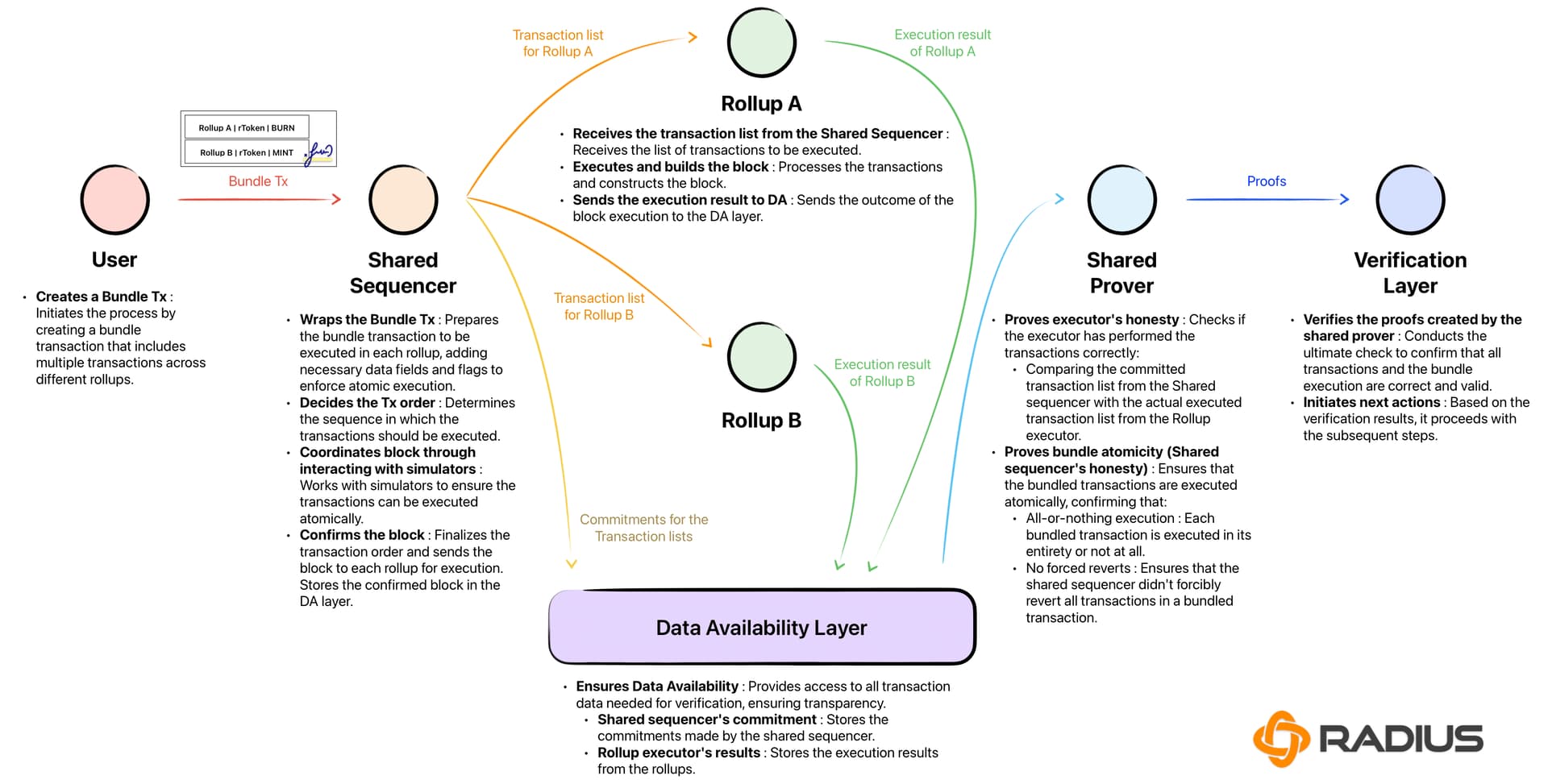
Traditional rollup architectures often operate in silos, where each chain maintains its own sequencer. This isolation creates fragmented liquidity and inefficient ordering for cross-rollup transactions. A shared sequencer solves this by ingesting transactions from multiple rollups—such as those built on the OP Stack—and ordering them in a single, unified stream.
| Feature | Isolated Sequencer | Shared Sequencer |
|---|---|---|
| Latency | Higher (cross-chain hops) | Lower (atomic execution) |
| MEV Exposure | High (fragmented arbitrage) | Reduced (fair ordering) |
| Capital Efficiency | Low (duplicate bridging) | High (direct settlement) |
The core mechanism relies on synchronous atomic execution. Instead of treating a cross-rollup swap as two separate events, the shared sequencer bundles the source transaction and the destination transaction into a single atomic block. If either part fails, the entire operation reverts. This ensures that liquidity moves between rollups without the risk of stuck funds or failed intermediate states.
This approach is critical for maintaining fairness. Without a shared ordering layer, sophisticated actors could exploit latency differences between isolated chains to front-run trades or capture arbitrage opportunities that should be shared across the ecosystem. By treating all transactions from different rollups as equal participants in a single queue, the shared sequencer neutralizes these informational advantages.
The Optimism Superchain demonstrates this coordination effectively. By leveraging shared sequencing infrastructure, OP Stack chains can settle cross-chain transfers with near-instant finality. This reduces the need for complex, multi-hop bridging solutions and allows developers to build applications that feel like they are running on a single, unified blockchain.
Optimism Superchain and atomic execution
The Optimism Superchain demonstrates how shared infrastructure can solve the fragmentation problem inherent in isolated Layer 2 networks. By utilizing a shared sequencer, multiple rollups—such as OP Mainnet and Base—can coordinate transaction ordering within a single block space. This architecture transforms cross-rollup interactions from asynchronous bridge waits into synchronous atomic executions, where swaps and liquidity movements settle instantly across chains.
In a traditional setup, moving assets between L2s requires bridging through Layer 1, introducing latency and higher costs. The Superchain’s design eliminates this friction by treating the sequencer as a central hub. When a user initiates a cross-chain swap, the shared sequencer bundles the necessary transactions for both chains into one atomic unit. If any part of the transaction fails, the entire operation reverts, ensuring that users never face partial fills or stuck funds.
This mechanism directly impacts liquidity efficiency. Arbitrage opportunities that previously relied on price discrepancies between isolated chains are now priced in instantly, as the shared sequencer can execute the arbitrage legs simultaneously. For protocol designers, this represents a shift from managing cross-chain bridges to managing shared sequencing contracts. The result is a unified liquidity layer where capital flows freely without the traditional overhead of bridge security audits or delayed finality.
Managing MEV in shared sequencing environments
Cross-rollup MEV represents a distinct category of value extraction that emerges when a single sequencer manages transactions across multiple Layer 2 networks. Unlike traditional MEV, which is often confined to a single chain’s mempool, cross-rollup opportunities arise from price discrepancies and liquidity imbalances between different L2s. When a shared sequencer consolidates these transactions, it gains the ability to execute non-atomic arbitrage, capturing value that would previously have been fragmented across isolated ecosystems.
The shift toward shared sequencing fundamentally alters the MEV landscape by creating new arbitrage vectors. As infrastructure matures, the ability to sequence transactions across rollups becomes a strategic advantage, turning order-flow design into a critical component of market design. This centralization of sequencing power allows operators to optimize block construction across chains, effectively merging previously siloed liquidity pools into a single, unified execution environment.
The Optimism Superchain serves as the primary real-world example of this architecture in action. By sharing a sequencer and settlement layer, the Superchain enables seamless asset movement and arbitrage between Optimism, Base, and other participating chains. This design demonstrates how shared infrastructure can reduce latency and cost for cross-rollup traders, while simultaneously introducing new complexities for protocol designers who must account for cross-chain front-running and sandwich attacks.
As shared sequencing becomes standard, the focus must shift from isolated chain security to cross-chain order-flow integrity. Protocols need to design mechanisms that can withstand non-atomic arbitrage, ensuring that liquidity providers and users are not unfairly extracted by sequencers with cross-chain visibility. This evolution marks a transition from simple transaction ordering to complex, multi-chain market design.


As an Amazon Associate, we may earn from qualifying purchases.
Choosing infrastructure for cross-rollup flows
Selecting the right sequencing layer depends on balancing decentralization, speed, and cost. Shared sequencers like Espresso provide a neutral ordering layer that treats all transactions equally, preventing front-running and ensuring equity across rollups. This approach is essential for protocols requiring strict fairness in cross-rollup arbitrage.
For teams prioritizing speed and cost-efficiency, the Optimism Superchain offers a proven model. Its shared sequencer infrastructure allows rollups to settle transactions quickly while maintaining security through the OP Stack. This setup minimizes latency for atomic execution, making it ideal for high-frequency trading and liquidity aggregation.
Alternatively, Celestia-based solutions offer decentralized sequencing as a service. By leveraging interchain security, new rollups can spin up with existing sequencer sets and stake, reducing the need to build custom ordering infrastructure from scratch. This model is particularly useful for developers seeking a balance between decentralization and operational simplicity.
When evaluating these options, consider the trade-offs. Shared sequencers offer neutrality but may introduce centralization risks if the provider is compromised. The Superchain model provides speed and ease of integration but relies on a specific ecosystem. Celestia-based solutions offer decentralization but may have higher complexity in setup and maintenance. Choose the infrastructure that aligns with your protocol's specific liquidity and security requirements.
Frequently asked questions about L2 sequencing
What is the difference between a sidechain and a rollup?
Rollups and sidechains are two powerful tools in the blockchain scalability toolkit. Rollups provide high security by leaning on Layer 1s, while sidechains prioritize speed and cost-effectiveness with independent operations. Rollups are by far the most popular type of L2 network, accounting for the most value and activity as of late 2025. This solution bundles hundreds of transactions off-chain, then posts compressed data to the main blockchain.
What is a cross-chain swap?
A crosschain swap lets you swap a token on one chain for a different token on another. For example, swapping USDT on Arbitrum to ETH on Base. Unlike traditional swaps conducted on centralized exchanges, crosschain swaps allow direct exchanges between blockchains. This mechanism is foundational for cross-rollup liquidity, enabling assets to move between ecosystems without relying on centralized intermediaries.
How do shared sequencers handle MEV?
Cross-rollup MEV refers to opportunities for value extraction that arise when transactions across different rollups can be profitably sequenced. The Shared Sequencer assumes a pivotal role in this context by ensuring equity and uniformity in Cross-Rollup transactions by treating all transactions equally. This reduces the advantage of front-running, though it remains an unsolved problem in shared sequencing architectures.
No comments yet. Be the first to share your thoughts!