Why isolated rollups fragment liquidity
The current rollup landscape operates like a collection of independent silos. Each rollup maintains its own sequencer, a fast-ordering engine that batches transactions and determines their execution order. While this model offers speed and low costs, it creates a critical mechanical flaw: liquidity is trapped within the boundaries of a single chain. When users interact with DeFi protocols spanning multiple rollups, they face a fractured experience where assets and data cannot move atomically.
This fragmentation is not merely an inconvenience; it is a structural vulnerability. Isolated sequencers process transactions in local orderings that are invisible to other chains. This lack of a shared view enables cross-rollup MEV (Maximal Extractable Value). As noted in industry analysis, cross-rollup MEV arises when transaction ordering across different rollups allows profit extraction that isolated sequencers cannot prevent or detect. A malicious actor can exploit the time lag between rollups to front-run or sandwich trades that span multiple chains, draining value from users who believe they are trading on a secure, decentralized layer.
Cross-rollup MEV arises when transaction ordering across different rollups allows profit extraction that isolated sequencers cannot prevent.
The result is a market where atomic execution—a single transaction that updates state across multiple rollups simultaneously—is impossible. Without a shared sequencing layer, cross-rollup composition relies on slow, trust-based bridges or manual wrapping, introducing friction and security risks. The absence of a common ordering layer means that the economic activity on one rollup does not naturally coordinate with another, leaving the ecosystem vulnerable to arbitrage attacks and liquidity fragmentation.
What shared sequencing actually does
Shared sequencing replaces isolated transaction ordering with a single operator set that sequences transactions for multiple rollups simultaneously. This mechanism enables atomic cross-rollup composition, allowing state changes across different chains to be settled as a single, indivisible unit. Instead of relying on slow, asynchronous bridges that fragment liquidity, shared sequencing treats distinct rollups as parts of a unified execution environment.
The technical benefit is precise: a shared sequencer orders transactions from different rollups in a single, deterministic sequence. When a user interacts with a decentralized exchange on one rollup and moves assets to a lending protocol on another, the shared sequencer can include both transactions in the same batch. If the first transaction fails, the second is rejected, ensuring that partial executions never occur. This atomicity eliminates the "bridge risk" where assets are locked in transit but not yet credited to the destination chain.
Shared sequencing extends this: one operator set sequences transactions for multiple rollups at once, enabling atomic cross-rollup composition.
This approach mirrors how traditional financial systems handle inter-bank transfers. Rather than settling each leg of a transaction independently, the system ensures that all legs succeed or fail together. For developers, this means complex multi-step DeFi strategies can be executed with the same reliability as single-chain operations, significantly reducing the complexity of cross-rollup integrations.
Atomic execution across rollups
Atomic execution transforms cross-rollup interactions from fragile, multi-step manual processes into single, indivisible transactions. When a shared sequencer orders transactions from multiple rollups in a single timeline, it can group dependent actions together. If any part of that group fails, the entire transaction reverts, ensuring that users never end up with partial state updates or lost funds.
This capability is essential for complex financial operations. Consider a user who wants to deposit stablecoins into a lending protocol on one rollup and use those funds as collateral to borrow assets on another. Without atomic execution, the user would need to submit separate transactions: first the deposit, then the borrow. If the second transaction fails due to slippage or liquidity issues, the user is left with locked assets and no borrowing power. With atomic execution, both steps are bundled. The sequencer ensures that the deposit only settles if the borrow can also complete successfully.
Research into cross-rollup atomic transaction execution, such as the CRATE framework, highlights how shared validity sequencing enables this trigger-action paradigm. Instead of relying on off-chain bridges or manual relays, smart contracts on one rollup can remotely invoke methods on another within the same atomic block. This eliminates the "cross-chain gap" where intermediate states leave funds exposed to risk.
The mechanical benefit is clear: synchronous execution removes the need for trust in intermediate steps. By treating cross-rollup interactions as a single unit of work, shared sequencers provide the composability of a monolithic chain without sacrificing the scalability of modular L2s.
Decentralized sequencing as a service
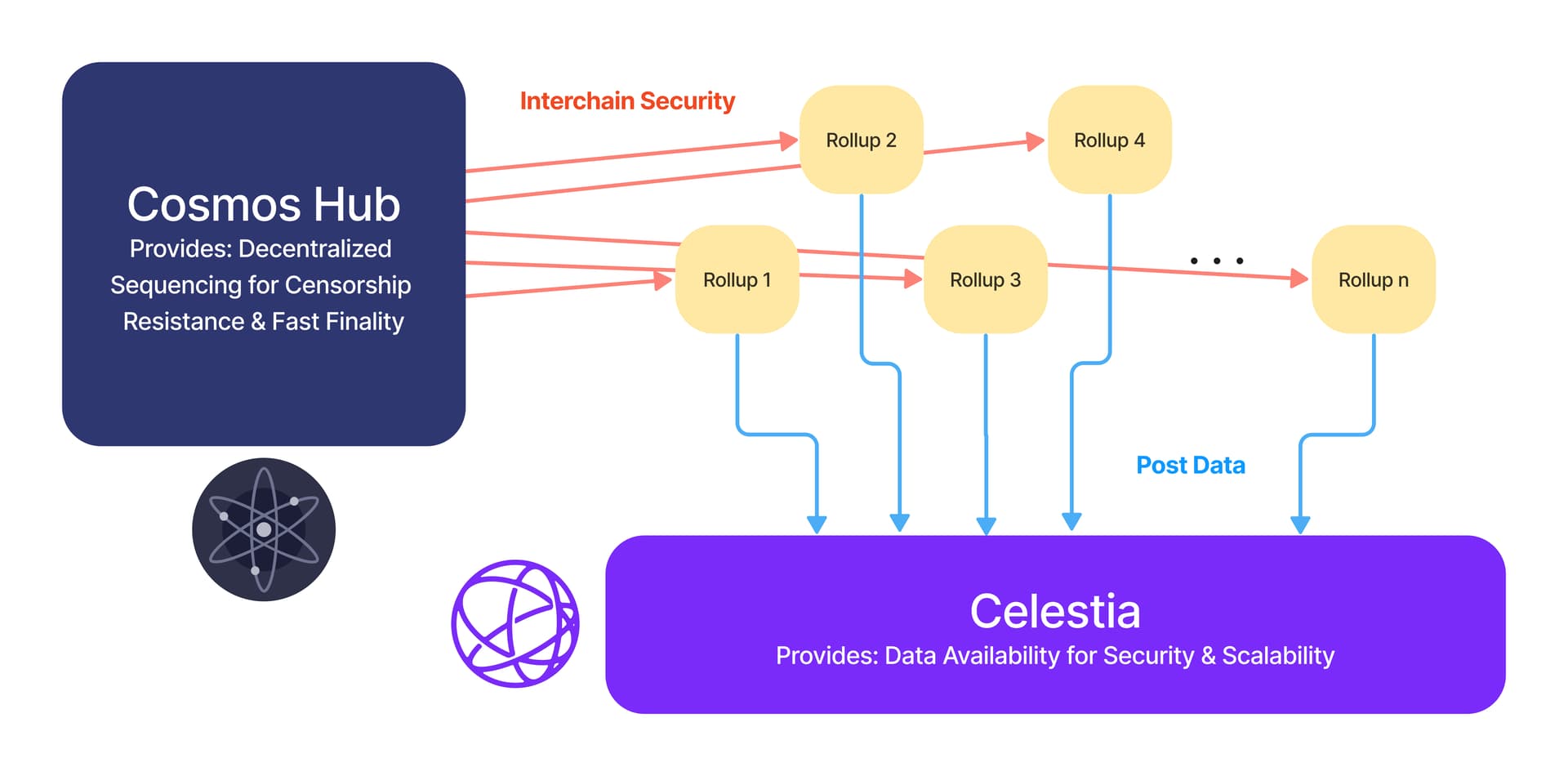
The current L2 landscape relies on centralized sequencers, creating a single point of failure and limiting cross-chain composability. A more robust approach treats sequencing as a shared infrastructure layer, similar to how Interchain Security secures Cosmos zones. By leveraging an existing set of validators and stake, new rollups can spin up decentralized sequencing without bootstrapping their own security model from scratch.
This "sequencing as a service" model allows multiple rollups to share the same ordering engine. Instead of isolated sequencing domains, transactions from different chains are ordered within a common pool. This shared ordering enables atomic execution across rollups, meaning a swap on one chain and a deposit on another can be confirmed in a single, consistent state transition. The mechanical benefit is immediate: reduced latency and the elimination of the trust assumptions required for cross-rollup bridges.
While this architecture offers a clear path to solving fragmentation, it remains largely in the experimental phase. Current implementations are planned rather than live production features, with teams actively testing the mechanics of shared state. As the infrastructure matures, we expect to see a shift from isolated sequencers to a unified ordering layer that underpins the next generation of scalable decentralized applications.
Common questions about rollup sequencing
Understanding the mechanical differences between rollup types and sequencing roles clarifies why shared infrastructure matters. The following answers address specific technical distinctions regarding atomic execution, security models, and transaction ordering.
No comments yet. Be the first to share your thoughts!