
Ethereum's rollup ecosystem has exploded, promising scalability through Layer 2 solutions, yet it grapples with a core inefficiency: fragmented transaction ordering. Cross-rollup sequencing emerges as a compelling fix, creating a shared sequencing layer Ethereum that synchronizes activity across rollups. This unification tackles latency head-on, enabling low-latency cross-rollup dApps that feel as fluid as Layer 1 interactions. From my vantage in risk management for blockchain projects, this isn't just technical wizardry; it's a hedge against the silos eroding user trust and liquidity.
Navigating Fragmentation in the Rollup Landscape
Picture this: dozens of rollups, each with its own sequencer dictating transaction order. Liquidity splinters, states diverge, and cross-rollup moves turn into odysseys. A simple asset swap between Rollup A and B? It demands bridging waits, finality checks, and often inflated gas fees. This setup breeds latency arbitrage, where fast actors exploit delays for MEV capture shared sequencers could otherwise neutralize.
Recent analyses, like those decoding rollup varieties from sovereign to based, underscore how design divergences amplify these pains. Users endure suboptimal composability; developers wrestle with interoperability hurdles. In a maturing ecosystem, such fragmentation risks stalling adoption, as dApps can't thrive in isolation. Shared sequencers step in here, defragmenting without compromising decentralization, security, or cost structures, as Zeeve's insights affirm.
Core Mechanics of Cross-Rollup Sequencing
At its heart, cross-rollup sequencing deploys a decentralized network to batch and order transactions for multiple rollups simultaneously. Sequencers, once siloed, now collaborate via a shared layer, posting unified batches to Ethereum L1. This yields synchronous state visibility: rollups glimpse each other's updates in the same block window.
Benefits cascade from there. Atomic cross-rollup transactions execute or revert holistically, slashing multi-step risks. MEV extraction diminishes as ordering becomes collective, curbing sandwich attacks across chains. Censorship resistance strengthens too, with no single sequencer gatekeeping inclusion. Jarrod Watts nails it in his sequencer guide: interoperability perks add outsized value, fostering a cohesive Web3 fabric.
Comparison of Solo Sequencing vs Shared Sequencing
| Sequencer Model | Latency | Interoperability | MEV Risk | Decentralization |
|---|---|---|---|---|
| Solo | High | Low | High | Variable |
| Shared | Low | High | Low | Strong |
Yet, implementation demands nuance. Delegated Proof of Stake models, as explored in recent papers, offer paths to decentralize without DPoS pitfalls like collusion. Orchestrators routing flow to rollups, per Ethereum Research, optimize batch efficiency, but hinge on robust incentives.
Spotlight on Leading Shared Sequencing Initiatives
Projects are turning theory into practice. Espresso Systems' sequencer acts as VM-agnostic middleware, decentralizing ordering while baking in data availability. It slots between rollups and L1, delivering high-throughput with low latency, a boon for risk-averse operators eyeing rollup interoperability solutions.
Radius pushes boundaries further with synchronous atomic execution. Bundled transactions from disparate rollups verify faster than full finality, ensuring security amid speed. This addresses Ethereum rollup transaction ordering chaos directly, minimizing exposure to reorgs or liveness failures.
Shared sequencers coordinate ordering for multiple rollups, boosting liveness and cutting MEV, as Cube Exchange highlights.
From a hedging lens, these innovations balance upside scalability with downside protections. But as Gate. com charts in Rollup 2.0, the sequencer battle rages; delegated sequencing rollups must prove resilient against centralization creep.
Centralization creep lurks as the primary threat, where a handful of sequencer nodes could collude or fail, echoing the vulnerabilities of today's centralized setups. My 14 years in risk management scream for diversified node operators and slashing mechanisms to align incentives. DPoS-inspired delegated sequencing rollups offer a middle ground, distributing power via staking while curbing plutocracy risks, as detailed in recent academic explorations.
Fortifying Security in the Shared Sequencing Era
Security isn't optional; it's the bedrock. Shared sequencers must withstand reordering attacks, where malicious actors manipulate cross-rollup order for profit. Robust proofs and multi-signature schemes verify batch integrity before L1 posting. Liveness faults, too, demand attention: if sequencers go offline, rollups halt. Redundancy pools and fallback to L1 ordering mitigate this, ensuring no single failure cascades.
Ethereum Technical Analysis Chart
Analysis by David Anderson | Symbol: BINANCE:ETHUSDT | Interval: 1D | Drawings: 6
Technical Analysis Summary
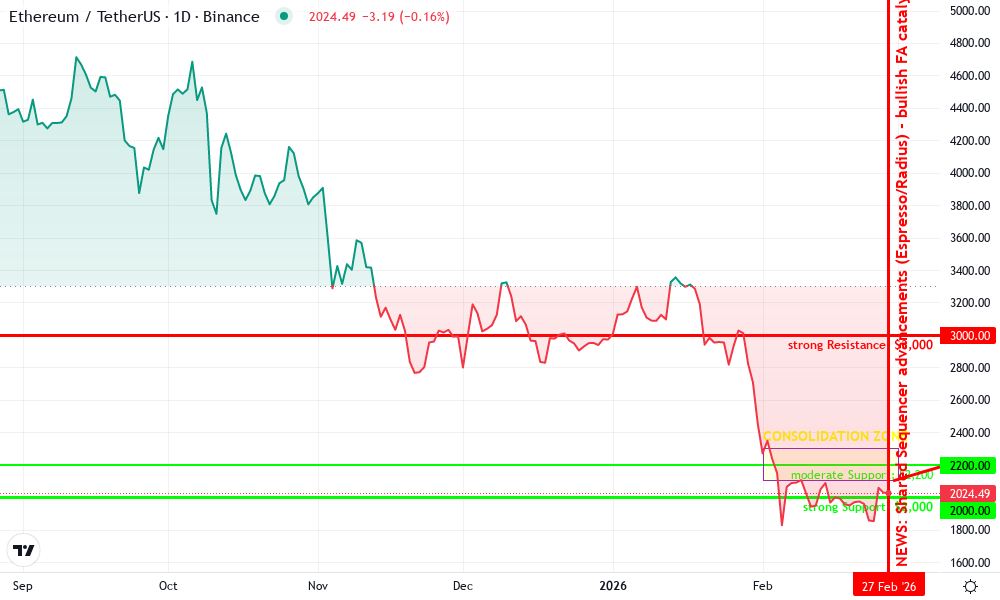
As David Anderson, with my conservative hybrid approach emphasizing risk management first, I recommend the following precise drawing instructions on this ETHUSDT daily chart spanning late 2025 into early 2026 (adjusted to 2026 context): 1. Draw a 'trend_line' connecting the swing high at 2026-11-15 ~$4,400 to the recent low at 2026-02-28 ~$2,100, labeling it 'Primary Downtrend - Bearish Channel Upper (Confidence 0.85)'. Extend it rightward. 2. Add a parallel 'trend_line' from 2026-10-20 ~$3,800 low to 2026-01-10 ~$2,800 support, labeling 'Minor Uptrend Support - Watch for Break'. 3. Place 'horizontal_line' at $2,000 (strong support), $2,500 (moderate resistance), $3,000 (strong resistance), and $2,200 (near-term pivot). 4. Use 'rectangle' for consolidation zone from 2026-02-01 to 2026-03-01 between $2,100-$2,300. 5. Add 'long_position' zone at $2,050-$2,100 entry with SL below $1,950. 6. Mark 'arrow_mark_down' on MACD bearish crossover around 2026-02-15. 7. 'callout' on declining volume since Dec 2026 peak: 'Volume Divergence - Weakening Downmove'. 8. 'vertical_line' at 2026-02-27 for 'Shared Sequencer News Catalyst'. 9. 'text' note: 'Risk Low: Wait for $2,000 hold + MACD bullish cross'. This setup prioritizes tight risk controls while eyeing FA tailwinds from rollup advancements.
Risk Assessment: medium
Analysis: Bearish TA downtrend risks further to $1,800 if support breaks, but FA tailwinds from rollup decentralization reduce long-term downside; low conviction volume mitigates immediate crash risk
David Anderson's Recommendation: Hold cash or tight longs at support only - manage risk first with 1% max exposure, await $2,000 hold + MACD flip for scale-in
Key Support & Resistance Levels
📈 Support Levels:
- $2,000 - Psychological + historical multi-month low, strong confluence strong
- $2,200 - Recent swing low + 50% fib retrace of Dec rally moderate
📉 Resistance Levels:
- $2,500 - Near-term overhead from Feb consolidation high weak
- $3,000 - Prior Dec low-turned-resistance, channel midline strong
Trading Zones (low risk tolerance)
🎯 Entry Zones:
- $2,050 - Bounce from strong support $2,000 with volume spike confirmation, aligns with FA catalysts low risk
🚪 Exit Zones:
- $2,800 - Measured move target to moderate resistance, 1:3 RR 💰 profit target
- $1,950 - Below strong support invalidation, tight 1% risk 🛡️ stop loss
Technical Indicators Analysis
📊 Volume Analysis:
Pattern: declining on downside
Bearish divergence - price lows with lower volume indicates weakening sellers
📈 MACD Analysis:
Signal: bearish crossover
MACD line below signal since mid-Feb, momentum fading but watch for bullish divergence
Applied TradingView Drawing Utilities
This chart analysis utilizes the following professional drawing tools:
Disclaimer: This technical analysis by David Anderson is for educational purposes only and should not be considered as financial advice. Trading involves risk, and you should always do your own research before making investment decisions. Past performance does not guarantee future results. The analysis reflects the author's personal methodology and risk tolerance (low).
From a portfolio perspective, I advise operators to stress-test integrations. Espresso's design shines here, embedding data availability to preempt disputes. Radius complements with atomic bundling, where proofs confirm execution before finality, slashing dispute windows. Yet, integration costs loom; rollups must upgrade without disrupting live traffic. HackMD's defragmentation analysis illustrates this via token transfers: shared ordering collapses multi-hop bridges into single steps, but only if proofs align perfectly.
MEV capture shared sequencers promise a fairer arena. By pooling order flow, they democratize extraction, routing profits back via auctions rather than insider grabs. Galaxy's crypto digest flags this as a pro, though cons like network congestion during peaks warrant caution. Developers building low-latency cross-rollup dApps, think DeFi aggregators or NFT marketplaces spanning chains, gain atomic composability without custom bridges.
Practical Pathways for Rollup Operators and Developers
Adopting cross-rollup sequencing starts with assessment. Evaluate your rollup's VM compatibility; Espresso's agnosticism eases entry. Next, stake into the sequencer network, balancing yield against slashing exposure. For dApp builders, leverage SDKs for atomic calls: submit bundles that span rollups, reverting on any failure. HackerNoon's rollup guide stresses security enhancements here, advocating hybrid proofs for validity and availability.
Incentives drive adoption. Sequencer fees, split among operators, must outpace L1 costs. Rollup 2.0's sequencer showdown, per Gate. com, pits permissionless pools against bonded sets; the former scales better but invites sybils. Zeeve champions shared models for preserving decentralization sans performance hits. Cube Exchange extends this to Web3 at large: cross-chain atomicity beckons, with sequencers as the glue.
Risk-hedged portfolios favor phased rollouts. Start with testnets, monitor liveness scores, then scale. Ethereum Research's orchestrator routing optimizes this, funneling flow to idle sequencers for efficiency. The Superchain Thesis dives deeper into atomic trades via shared sequencers in OP Stack ecosystems, a blueprint for optimistic rollups. Explore how shared sequencers enable atomic cross-rollup trades.
Challenges persist, no doubt. Sovereign rollups resist shared layers, preferring autonomy; based rollups tie to L1, diluting benefits. Aiden Park's rollup decode maps these trade-offs, urging hybrids. Still, momentum builds. As fragmentation fades, Ethereum reclaims its crown: a scalable base for dApps that interact fluidly, risks managed, rewards unlocked.




No comments yet. Be the first to share your thoughts!