

Ethereum's rollup-centric roadmap has driven impressive scalability gains, with Layer 2 networks processing thousands of transactions per second at fractions of Layer 1 costs. Yet beneath this progress lurks a persistent vulnerability: the dominance of centralized sequencers in most rollups. These single points of control order transactions, but they expose users to censorship risks, liveness failures, and unchecked MEV capture. As Ethereum's ecosystem matures, cross-rollup sequencing emerges as a measured solution to decentralize ordering while fostering true Ethereum L2 interoperability.
Current market conditions underscore the stakes. Ethereum trades at $1,971.61, down 2.44% over the past 24 hours, reflecting broader caution amid scalability debates. Rollup sequencer risks amplify in volatile periods, where a single outage or adversarial sequencer could halt cross-chain activity and erode confidence. Investors must weigh these frailties against long-term value in modular architectures.
Rollup Sequencer Risks Undermine Decentralization
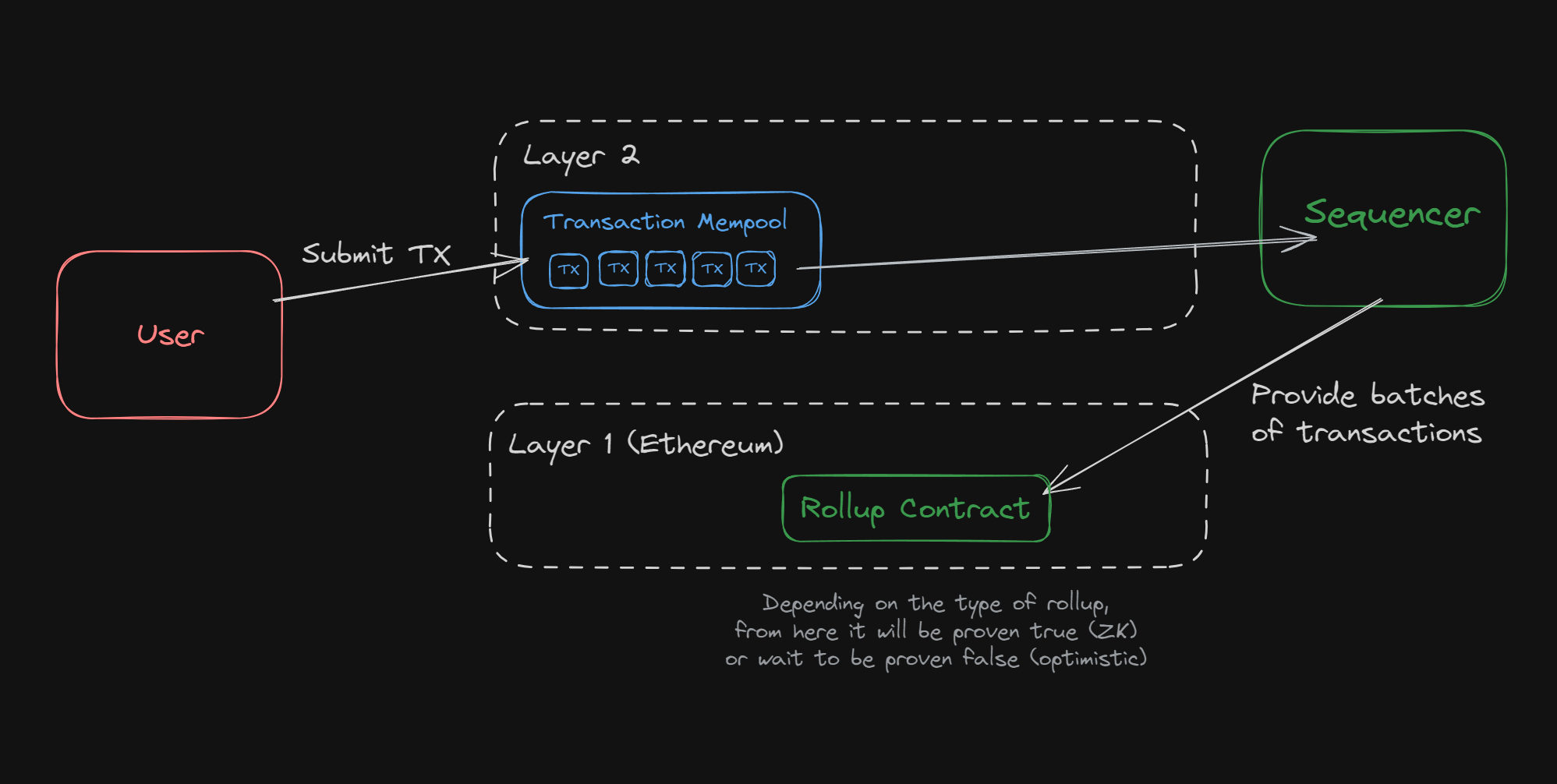
Centralized sequencers, often run by a lone operator or small set, dictate transaction inclusion and ordering. This setup invites rollup sequencer risks like censorship, where the sequencer favors certain transactions or blocks others, potentially stifling DeFi protocols reliant on timely execution. Liveness issues compound the problem; a downed sequencer freezes the rollup, stranding funds and disrupting dApps.
MEV extraction stands out as the sharpest threat. In solo-sequencer rollups, operators capture nearly all MEV capture rollups opportunities, from arbitrage to liquidations, without redistribution. Cross-rollup MEV exacerbates this, as fragmented ordering across chains prevents unified value extraction. Sources highlight how these dynamics fragment liquidity, forcing users into cumbersome bridges prone to slippage and delays. A distributed sequencer set might mitigate latency trade-offs, but without coordination, MEV leakage persists.
Atomic cross-rollup swaps remain impossible without shared sequencing, trapping liquidity in silos.
From a conservative lens, these centralization vectors contradict Ethereum's ethos. Rollups promise sovereignty, yet sequencer monopolies reintroduce trusted intermediaries, echoing pre-proof-of-stake pitfalls.
Centralized Sequencers vs. Shared Sequencers: Key Comparisons
| Aspect | Centralized Sequencers | Shared Sequencers |
|---|---|---|
| Monopoly Risk | High - Single operator dominance ❌ | Low - Decentralized network ✅ |
| Censorship | Vulnerable - Operator can block txs ❌ | Resistant - Distributed validators ✅ |
| Liveness | Single point of failure ❌ | Redundant nodes 🟢 |
| MEV Extraction | Centralized control by operator 💰 | Redistributed via auctions/staking 💰🔄 |
| Cross-Rollup Composability | Slow bridging required 🔄 | Atomic swaps & ordering 🔗 |
| Stake-Slashing | N/A ❌ | Misbehavior penalized ✅ |
| Redundancy | None - Downtime risks ❌ | Failover across nodes ✅ |
| Example Projects | Optimism, Arbitrum, Base | Espresso (HotShot), Astria (lazy sequencer) |
Critically, shared models redistribute MEV via auctions or staking rewards, aligning incentives with network health. Starknet's app-chain experiments and OP Stack integrations signal maturing adoption, though latency in distributed setups warrants scrutiny.
Navigating Challenges in Cross-Rollup Sequencing Adoption
Transitioning to cross-rollup sequencing demands rigorous due diligence. Security hinges on sequencer set decentralization; a colluding minority could still censor. Economic attacks loom if MEV stakes concentrate power. Moreover, integrating diverse rollup stacks - from optimistic to ZK - tests protocol robustness.
Yet the upside justifies patience. Enhanced Ethereum L2 interoperability unlocks seamless dApp ecosystems, from unified lending markets to frictionless NFTs. As non-based rollups evolve toward based sequencing, market fragmentation recedes. Roadmaps emphasize trustless resilience; detailed insights await here.
Ethereum (ETH) Price Prediction 2027-2032
Conservative estimates amid cross-rollup sequencing advancements enhancing rollup interoperability and decentralization
| Year | Minimum Price | Average Price | Maximum Price | YoY Change % (Avg) |
|---|---|---|---|---|
| 2027 | $1,800 | $2,500 | $3,500 | +27% |
| 2028 | $2,000 | $3,200 | $4,800 | +28% |
| 2029 | $2,500 | $4,100 | $6,200 | +28% |
| 2030 | $3,200 | $5,300 | $8,000 | +29% |
| 2031 | $4,000 | $6,800 | $10,500 | +28% |
| 2032 | $5,100 | $8,700 | $13,500 | +28% |
Price Prediction Summary
Ethereum's price is projected to experience steady conservative growth from 2027 to 2032, driven by cross-rollup sequencing solutions that address centralized sequencer risks, improve L2 interoperability, and boost scalability. Average prices rise from $2,500 to $8,700, reflecting ~28% CAGR, with min/max capturing bearish delays and bullish adoption surges.
Key Factors Affecting Ethereum Price
- Implementation of shared sequencers (e.g., Espresso, Astria) reducing censorship, liveness risks, and cross-rollup MEV
- Enhanced rollup composability enabling atomic swaps and liquidity unification
- Ethereum scalability roadmap progress lowering fees and increasing throughput
- Market cycles with potential 2028-2029 bull phase post-improvements
- Regulatory clarity supporting institutional inflows
- Competition from L1 alternatives and adoption hurdles in bear scenarios
Disclaimer: Cryptocurrency price predictions are speculative and based on current market analysis. Actual prices may vary significantly due to market volatility, regulatory changes, and other factors. Always do your own research before making investment decisions.
With ETH at $1,971.61, investors eye these shifts for compounded returns. Conservative strategies favor protocols proving sequencer decentralization empirically, prioritizing liveness over hype-driven yields.
Projects pioneering decentralized sequencing layer solutions merit close examination. Espresso Systems deploys its HotShot consensus for a global confirmation layer, delivering sub-second finality across rollup types. This BFT-style protocol stakes validators on honest ordering, slashing malicious actors to enforce liveness. Astria complements with a lazy sequencer model, offloading execution while committing ordered mempools to Ethereum. Both address rollup sequencer risks head-on, yet demand validation through testnets before full deployment.
Balancing MEV Redistribution and Economic Security
MEV capture rollups evolves under shared regimes. Centralized operators hoard proceeds, but distributed sequencers enable auctions where proposers bid for slots, redistributing surplus to stakers or users. Cross-rollup MEV unlocks arbitrage across chains, yet requires precise ordering to prevent front-running across silos. Stanford insights reveal bridging frictions amplify slippage; unified sequencing minimizes these, though validator collusion risks persist.
Conservative investors scrutinize stake distributions. Thresholds for censorship resistance must exceed 33% in BFT setups, with economic penalties deterring attacks. Ethereum's $1,971.61 price reflects tempered optimism; l2TVL growth hinges on sequencer reliability amid 2.44% daily dips. Protocols ignoring these mechanics risk capital flight during stress tests.

Empirical data from Starknet forums underscores app-chain synergies, where shared blocks consolidate Pragma and Kakarot transactions. OP Stack pursuits toward based rollups signal convergence, detailed in analyses of atomic trades via shared sequencers. Yet distributed latency - often 100-500ms added - challenges high-frequency DeFi.
Investment Thesis: Patience in Cross-Rollup Sequencing
Comparison of Leading Shared Sequencer Projects
| Project | Consensus Type | MEV Model | Decentralization Score | Ethereum L2 Interoperability Features | Finality Speed | Censorship Resistance |
|---|---|---|---|---|---|---|
| Espresso Systems | HotShot/BFT | Auction | 9/10 | Global confirmation layer, atomic cross-rollup swaps, enhanced composability | ⚡⚡⚡ (Rapid) | 🔒🔒🔒 (High) |
| Astria | Lazy Ordering | Staking | 8/10 | Shared transaction ordering, liveness & censorship resistance for multiple rollups | ⚡⚡ (Moderate) | 🔒🔒 (High) |
| Taiko | Decentralized BFT | Auction/Staking | 9/10 | Based rollup support, cross-rollup MEV mitigation, sequencer decentralization | ⚡⚡⚡ (Fast) | 🔒🔒🔒 (High) |
From a fundamental standpoint, cross-rollup sequencing fortifies Ethereum's modular future without upending proven stacks. Rollups retain data availability on L1, preserving sovereignty while outsourcing ordering. This hybrid tempers centralization without purity traps of full decentralization.
Market fragmentation yields to composability; imagine lending protocols spanning Arbitrum and Optimism without bridges. Cube Exchange notes reduced MEV leakage bolsters liveness, vital as ETH holds $1,971.61 amid volatility. DWF Labs posits based rollups as evolutionary, fostering compatibility sans overhauls.
Due diligence favors audited testnets and validator diversity. 2025 roadmaps project maturity, with interoperability transformations unfolding as outlined here. Investors allocating to sequencer-native tokens or L2s with migration paths position for asymmetric upside, grounded in liveness proofs over speculative narratives.
Ethereum's trajectory rewards those dissecting sequencer economics. At $1,971.61, with highs near $2,022, the network absorbs shocks, underscoring resilience. Cross-rollup sequencing cements this, bridging silos toward a unified L2 economy where value flows unhindered.




No comments yet. Be the first to share your thoughts!