Why shared sequencing matters for rollups
Most Layer 2 rollups currently run their own sequencers—single operators or tightly controlled services that accept transactions, decide their order, and provide fast confirmations. This setup works for isolated chains, but it creates fragmentation. When different rollups operate in silos, cross-rollup composability becomes difficult, expensive, and slow. Users must bridge assets across multiple layers, and developers face high friction when building applications that span several networks.
Shared sequencers address this by pooling resources across multiple rollups. Instead of each chain managing its own sequencing infrastructure, a shared network handles transaction ordering for several L2s simultaneously. This consolidation offers stronger economic security and censorship resistance because the cost of attacking the sequencer increases with the number of rollups it supports. It also reduces fragmentation by enabling native cross-rollup communication.
By moving sequencing to a shared layer, developers can build applications that treat multiple rollups as a single liquidity and execution environment. This shift is critical for the next wave of DeFi and gaming applications that require low-latency, cross-chain interactions without the overhead of traditional bridging.
How cross-rollup atomic execution works
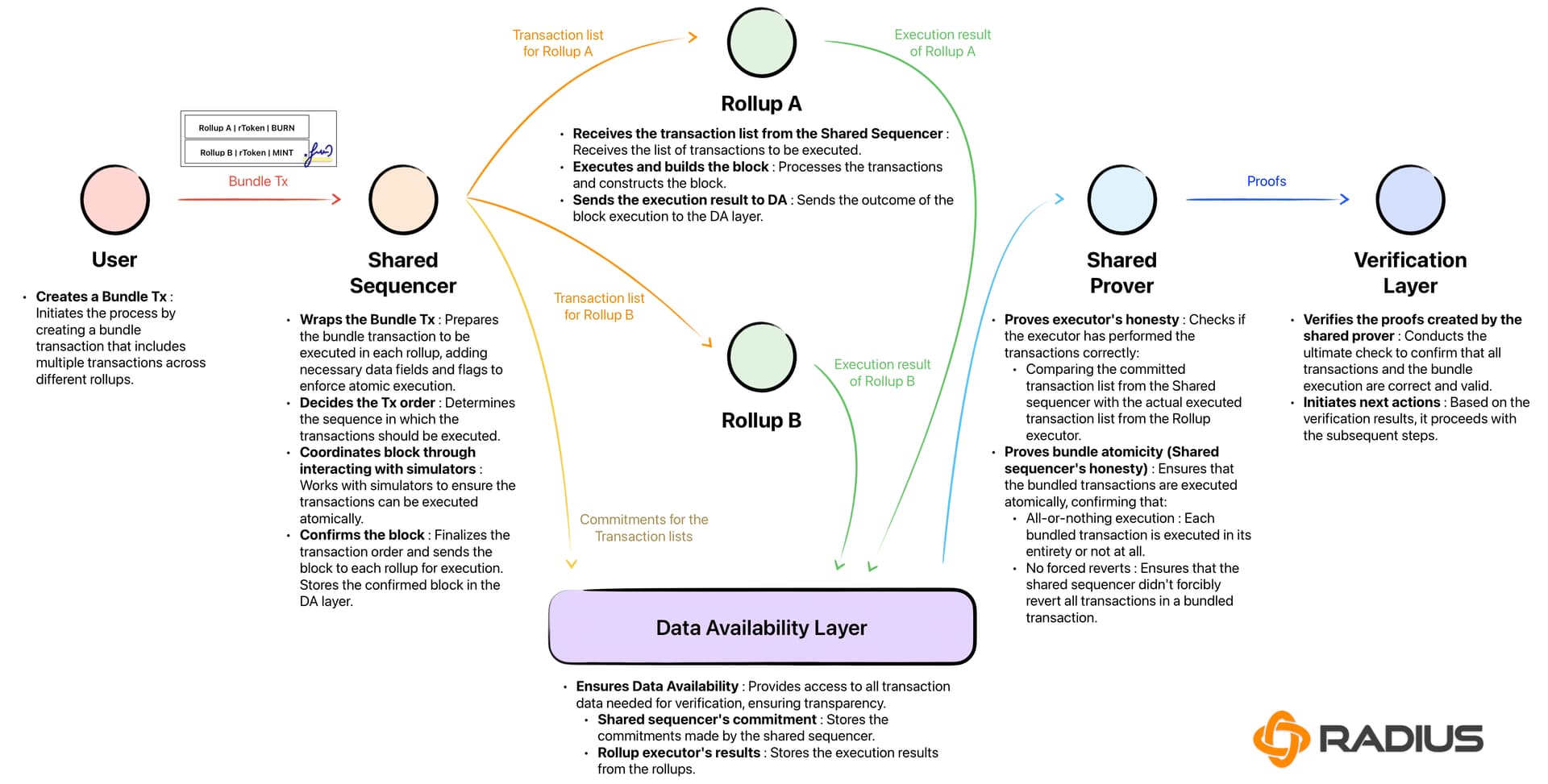
Cross-rollup atomic execution allows transactions on separate Layer 2 networks to be ordered and settled as a single, indivisible unit. Instead of treating each rollup as an isolated silo, a shared sequencer acts as the central coordinator, ensuring that actions across different chains happen simultaneously or in a strict, verifiable sequence.
1. Transaction Submission and Batching
Users submit transactions to their respective rollup contracts or via specific API endpoints provided by the shared sequencer infrastructure. The sequencer collects these disparate transactions into a unified batch. This step is critical because it aggregates the intent from multiple distinct L2 environments into a single payload that can be processed together.
The shared sequencer receives transactions from different rollups. It validates signatures and checks for basic feasibility before adding them to the pending order book. This ensures that only valid intents enter the atomic execution pool.
2. Ordering and State Resolution
Once the batch is assembled, the sequencer determines the precise execution order. This is where the "atomic" nature of the execution comes into play. The sequencer resolves state conflicts between rollups, ensuring that if Transaction A on Rollup X depends on Transaction B on Rollup Y, the order is preserved. This ordering is not just for display; it dictates the final state of assets across both networks.
The sequencer applies a deterministic ordering algorithm to the mixed batch. It ensures that dependent operations across different rollups are processed in the correct sequence, preventing race conditions or partial executions that could leave assets stranded.
3. Execution and Proof Generation
The ordered batch is then executed. In many shared sequencer architectures, this execution happens in a shared execution environment or is verified by a shared validity layer. The system generates a single proof or state root that covers all transactions in the batch. This proof attests that the cross-rollup atomic execution was performed correctly according to the predefined rules.
The sequencer executes the transactions in the determined order. If the architecture uses a shared validity sequencer, this step may involve generating a zero-knowledge proof that covers the state transitions across all involved rollups, ensuring mathematical certainty of the outcome.
4. Settlement and State Update
Finally, the result of the atomic execution is settled. The state updates for each involved rollup are posted to their respective L1 chains (or data availability layers). Because the execution was atomic, either all state changes are committed, or none are. This guarantees composability: a swap on one rollup and a deposit on another are guaranteed to succeed or fail together, eliminating the risk of partial fills or broken cross-chain states.
The final state root is submitted to the underlying Layer 1. Each rollup updates its local state based on the shared proof. Users see their balances and positions updated across both chains simultaneously, completing the atomic cycle.
Comparison: Single Rollup vs. Shared Sequencing
The shift from isolated sequencing to shared atomic execution fundamentally changes how cross-rollup applications behave.
| Feature | Single Rollup | Shared Sequencing |
|---|---|---|
| Latency | High (bridge delays) | Low (atomic sync) |
| Composability | Limited (manual bridges) | High (native execution) |
| Security | Dependent on bridge | Dependent on sequencer trust |
Community Perspective
Developers are actively debating the trade-offs of trust assumptions in shared sequencers. While the technical benefits are clear, the decentralization of the sequencer layer remains a key topic of discussion.
Developer Tools
To build and test these cross-rollup applications, developers need robust infrastructure. The following tools are commonly used for managing L2 nodes and testing atomic execution flows.


As an Amazon Associate, we may earn from qualifying purchases.
Top shared sequencer providers to consider
Cross-rollup bridging functions similarly to cross-chain bridging, except the two rollups may or may not share the same consensus protocol. Shared sequencers solve this fragmentation by acting as a neutral ordering layer. Instead of each rollup maintaining its own isolated sequencer, these providers accept transactions from multiple chains, order them globally, and broadcast the resulting batches to the underlying L1. This approach significantly reduces the latency and cost of bridging assets between different L2 ecosystems.
Espresso Network
Espresso Network operates as the first decentralized shared sequencer built on its own Layer 1. It uses a consensus mechanism that allows multiple rollups to submit transactions to a shared ordering layer. This ensures that cross-rollup trades and bridge transfers are executed with atomicity, preventing front-running and ensuring that the state transitions on both chains remain consistent. Developers can integrate Espresso by routing their transaction submissions through the shared sequencer API before posting to their respective L2s.
Celestia
Celestia provides a modular data availability layer that serves as the foundation for decentralized sequencing. By leveraging its interchain security model, rollups can spin up new instances with decentralized sequencing by utilizing an existing set of sequencers and stake. This architecture allows teams to outsource the heavy lifting of transaction ordering and data availability, focusing instead on execution logic. Celestia’s high throughput and low cost make it a preferred choice for rollups that require frequent data posting without congesting the main Ethereum chain.
Cube Exchange
Cube Exchange focuses on simplifying the infrastructure required to run and manage sequencers. While many providers build their own ordering layers, Cube offers tools and services that help teams deploy, monitor, and secure their sequencing operations. This is particularly useful for teams that want to maintain some control over their ordering process while benefiting from shared infrastructure components. Cube’s platform integrates with various L2 solutions, providing a streamlined way to handle transaction ordering and data availability.
Development Tools and Hardware
Building and securing shared sequencer infrastructure requires specific developer tools and hardware. Below are recommended products for developers working on L2 integration and security.


As an Amazon Associate, we may earn from qualifying purchases.
Managing cross-rollup MEV risks
When a shared sequencer handles transactions for multiple rollups, it creates a unified view of the mempool. This visibility introduces cross-rollup Maximal Extractable Value (MEV), where operators can profit by reordering or front-running transactions across different chains. Unlike single-rollup MEV, which is often limited to one ecosystem, cross-rollup risks allow for complex arbitrage and sandwich attacks that span protocol boundaries.
The primary danger lies in the sequencer's ability to see pending orders from distinct rollups simultaneously. An operator could, for instance, front-run a deposit on Rollup A to manipulate the price oracle used by a lending protocol on Rollup B. Without cryptographic guarantees, the sequencer holds too much power, effectively acting as a centralized gatekeeper who can extract value from users before their transactions are finalized.
To mitigate these risks, developers should prioritize shared sequencer providers that implement verifiable randomness or decentralized proposer-builder separation (PBS). These mechanisms ensure that no single entity can consistently predict or manipulate transaction ordering. Look for infrastructure that offers transparent, auditable sequencing logs so you can verify that your transactions were processed fairly.
For developers building infrastructure that requires robust, low-latency connectivity to manage these risks, reliable hardware is essential. The following tools help maintain the stability needed for secure cross-rollup communication.


As an Amazon Associate, we may earn from qualifying purchases.
Choosing the right sequencer for your stack
Selecting a shared sequencer requires matching its technical architecture to your rollup’s verification model. The decision hinges on whether your stack prioritizes the finality guarantees of zero-knowledge proofs or the economic security of optimistic disputes.
For ZK rollups, latency is the primary constraint. You need a sequencer that can ingest transactions and distribute them to provers without introducing bottlenecks. Providers like AltLayer and Caldera offer infrastructure optimized for this high-throughput, low-latency environment, ensuring that proof generation remains the limiting factor rather than data ingestion.
Optimistic rollups have different requirements. They rely on dispute periods and data availability, making the sequencer’s role less about raw speed and more about reliable ordering and fault tolerance. In this context, the sequencer acts as the central hub for transaction ordering before data is posted to Layer 1. Solutions like Succinct or specialized nodes from major infrastructure providers often fit this model, where the sequencer’s output is verified by the broader network over time.
The choice also depends on your data availability needs. If you are building for cross-rollup interoperability, ensure the sequencer supports Shared Validity Sequencing (SVS) or similar protocols that allow atomic execution across chains. This capability is critical for maintaining state consistency when transactions span multiple rollups.


As an Amazon Associate, we may earn from qualifying purchases.
Common questions about shared sequencing
What role does a sequencer play in a rollup? A sequencer accepts transactions, decides their order, and provides fast confirmations before data is posted to the underlying chain. In many systems, this is a single operator, but shared sequencers distribute this role across multiple providers to reduce centralization risks and improve throughput.
What is a Layer 2 rollup? Layer 2 rollups process transactions off the main blockchain (Layer 1) and bundle the compressed data back to it. This reduces congestion and fees on the base layer while maintaining security. Optimistic and Zero-Knowledge (ZK) rollups are the two primary types, differing in how they validate transaction correctness.
What is a cross-chain protocol? Cross-chain protocols enable interoperability between different blockchain networks, allowing them to communicate and transfer assets. Shared sequencers simplify this by handling cross-rollup bridging similarly to cross-chain bridging, ensuring that data from one rollup can be reliably verified by another without complex manual wrapping.
No comments yet. Be the first to share your thoughts!